Why Net Promoter Score Surveys Get Ignored
 +20 XP
Case study
Why Net Promoter Score Surveys Get Ignored
After great service from a bank employee, a customer receives a Net Promoter Score survey that is cold, confusing and hard to answer. We look at the five mistakes in that one email and rebuild it into a short, human request that gets far more useful feedback.
+20 XP when you reach the endWhat you will learn
- Spot the five common mistakes in a standard NPS email
- Ask one clear question about a real experience, not a hypothetical one
- Understand why NPS is easy to misuse and hard to trust
Scroll to follow the story. The screen changes with you.
Based on the learnings from Growth.Design: The Ugly Truth About Net Promoter Score Surveys, presented in our own format.

Step 1 of 10
- The survey arrives
01
The setup
A customer leaves the bank happy, and a survey email arrives on the walk home.
Dan had a problem with his account, and a bank employee named James sorted it out. As Dan left, James mentioned that a survey might arrive, because his manager uses those scores to evaluate staff. Minutes later, a Bank of Oria notification lights up the phone.
TakeawayThe moment right after a good experience is the best time to ask for feedback, if you ask well.
 Wall of text
02
The problem
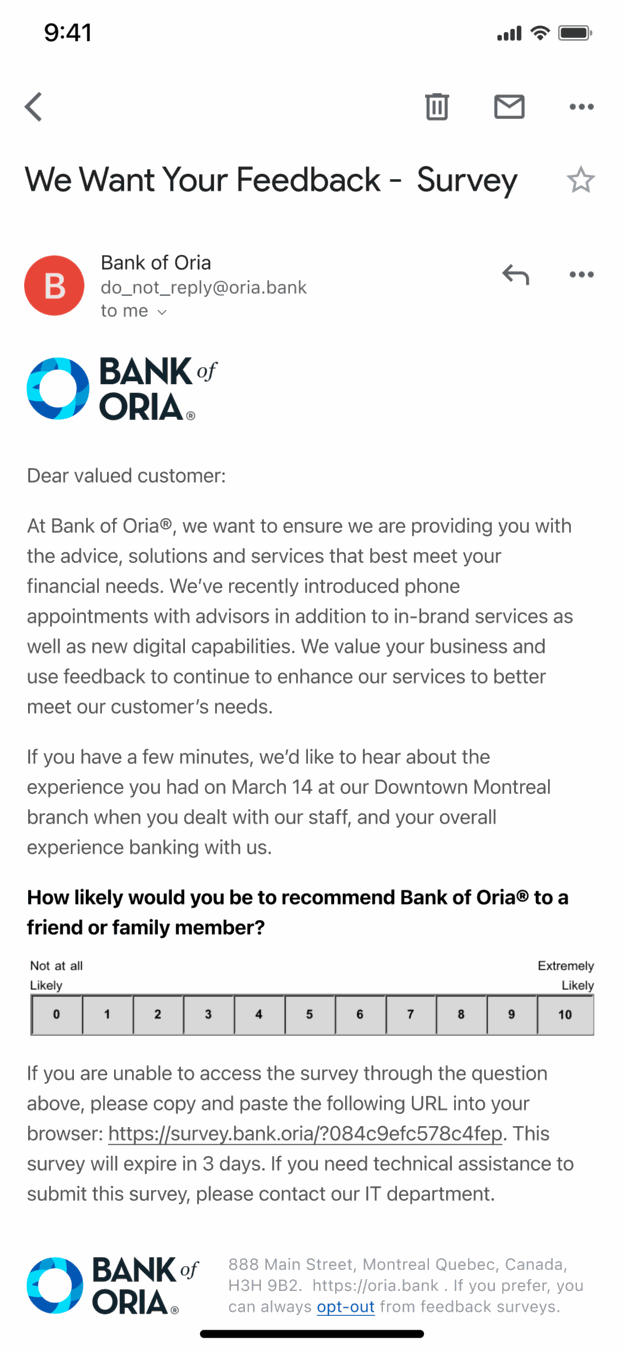
The email is long, formal and hard to answer on a phone.
It opens with 'Dear valued customer', follows with two dense paragraphs, then asks the standard 0 to 10 question and ends with a fallback link and instructions for the IT department. It feels like the answers will end up in a spreadsheet nobody reads. There are five separate problems here.
TakeawayIf a survey looks like a chore, most people will not start it.
 Same old subject
03
Mistake 1
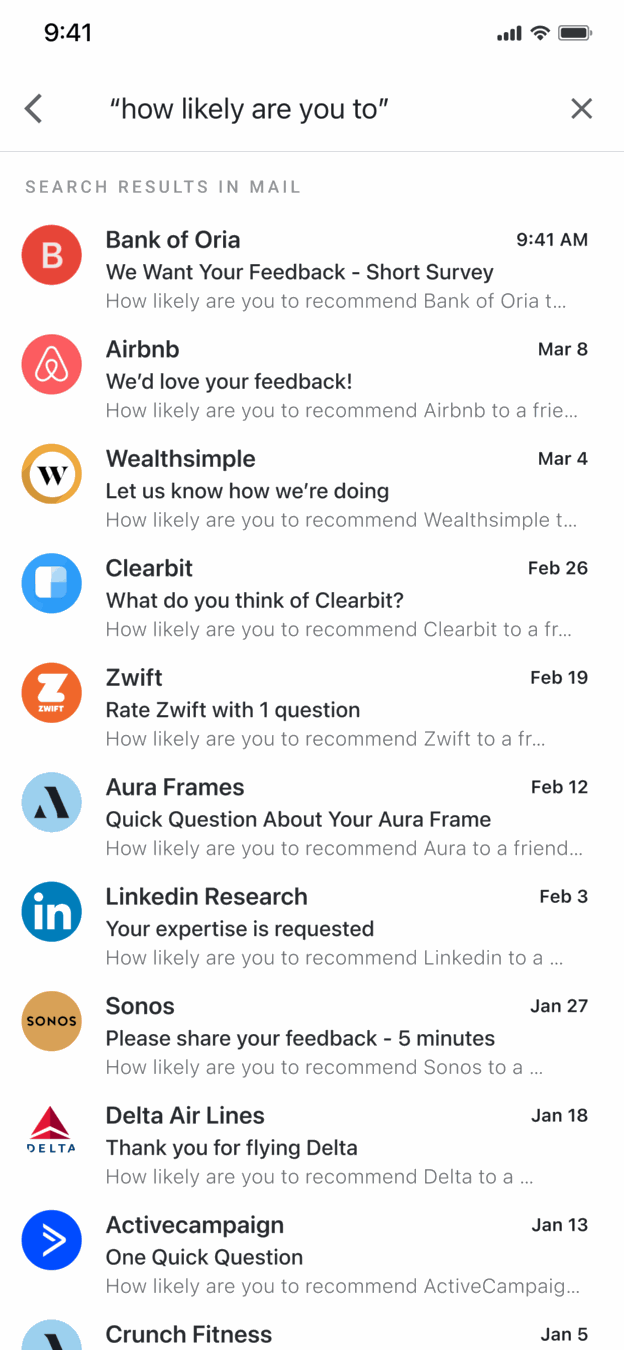
The subject line and question look like every other survey in the inbox.
'We Want Your Feedback' and 'How likely are you to recommend' appear in email after email from different companies. Dan gets roughly one of these a week, and now archives most of them without opening them.
TakeawayA request that looks like everyone else's gets filtered out before it is read.
Information filteringThe brain takes shortcuts to save energy, so we sort messages by pattern: sender, subject and layout. Growth.Design points to Andrew Chen's observation that clickthrough rates decline as tactics get overused, and, citing Constant Contact data, puts the average completion rate for NPS emails at about 3 percent.
 Dear valued customer
04
Mistake 2
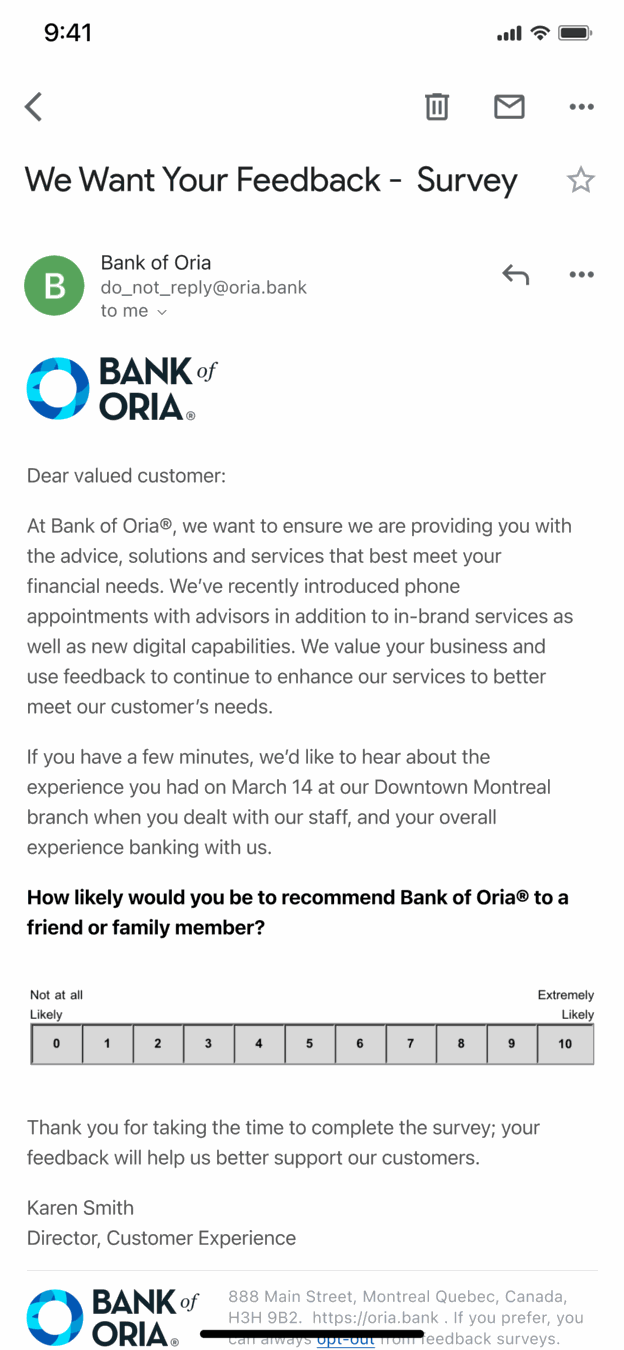
The email sounds like a corporate script, not like the person who helped.
If James spoke the way this email reads, he would sound like a robot. In person he would simply ask how the visit went and whether anything could be better. The warmth of the visit is lost the moment the survey arrives.
TakeawayWrite feedback requests in the voice of the person the customer actually met.
- Two questions in one
05
Mistake 3
One question asks about the staff and the whole bank at once.
The email asks about 'the staff' and 'your overall experience banking with us' in the same breath. If James was great but the bank itself is frustrating, what score should Dan give? A middling number could end up counting against James.
TakeawayOne question should measure one thing, or the answer means nothing.
Double-barreled questionsSurveyMonkey describes combining two subjects in one question as a double-barreled question. Because it is unclear what is being rated, the answers are unreliable.
- A hypothetical
06
Mistake 4
The question asks Dan to predict whether he will recommend a bank someday.
Read closely, 'How likely would you be to recommend' is not about today's visit. It asks Dan to guess his future behavior as a brand ambassador, based on one simple trip to a branch.
TakeawayAsk about what people just experienced, not what they might do in the future.
Why NPS is inaccurateAccording to Jared Spool and a Forbes analysis, NPS questions are often misunderstood because of their hypothetical wording, are a poor predictor of future loyalty and growth, and rest on noisy assumptions and arbitrary categories. Questions about past behavior are more reliable.
- Tiny targets
07
Mistake 5
Eleven tiny buttons on a phone screen make answering hard.
The 0 to 10 scale squeezes eleven options into one narrow row, and a thumb covers about four of them at once. Dan wanted to help James, but by now he feels like a data point for a faceless company.
TakeawayThe fewer and larger the choices, the more people finish and the cleaner the data.
Hick's law and Fitts' lawThe effort to decide grows with the number of options, and small buttons make it worse. Jared Spool notes that the 11 point scale adds complexity without making results more accurate or reliable.
Original Hard to answerRedesign 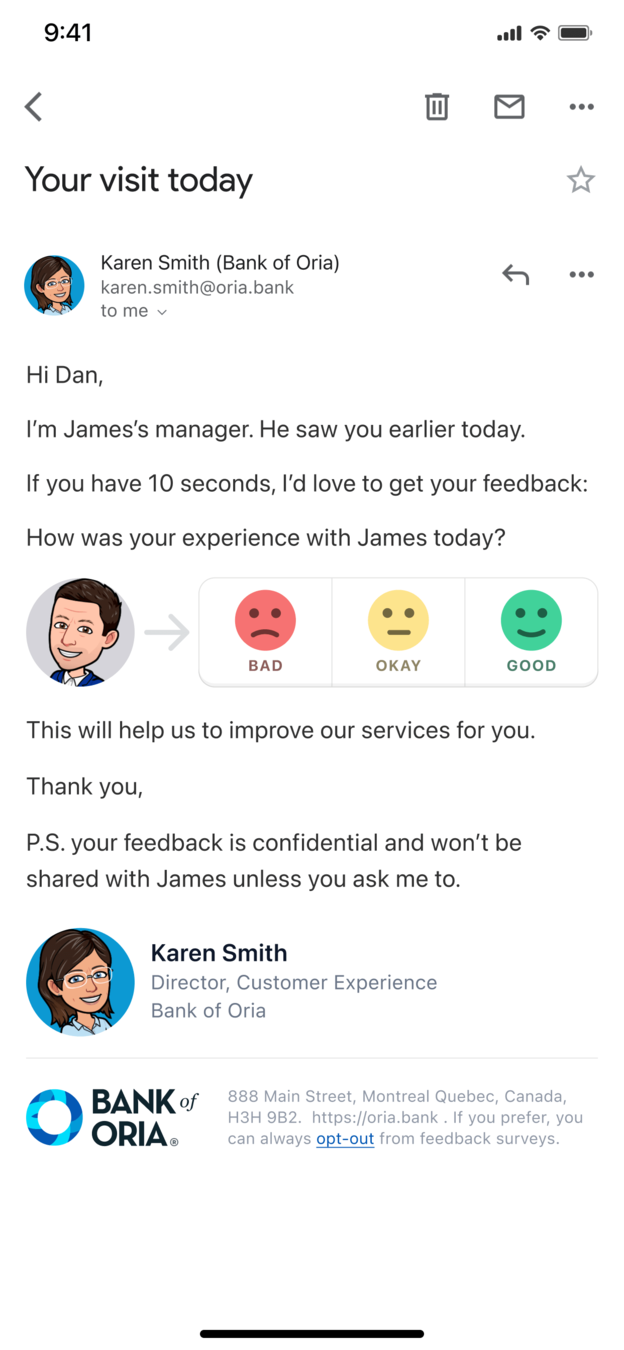 One tap answer
08
The repair
A short note from a real person, with one easy question about today.
The new email comes from James's manager, Karen. It is titled 'Your visit today', asks for ten seconds, and has one question with three large faces: bad, okay and good. A closing line says the feedback stays confidential unless Dan chooses to share it.
What changed
- Subject: 'Your visit today' instead of a generic request
- Intro: a short, personal note from a named manager
- Ask: 'If you have 10 seconds' and one question about James
- Benefits and conditions: why it helps, and that it is confidential
TakeawayRelevant, human, quick, clear and honest: each mistake has a simple fix.
- A human intro
09
The result
More people answer, and the answers explain what to improve.
Tapping a face opens a short page that thanks Dan and asks why, with a text box and a send button. Managers like Karen get more responses and specific comments they can act on. They still get a satisfaction score, but lose the standard NPS benchmark.
TakeawayA reason behind a score is worth more than the score itself.
- Survey overload
10
The bigger picture
When every company sends the same survey, customers stop answering all of them.
Companies focus so heavily on their Net Promoter Score that they send the same one size fits all question everywhere. The result is an inbox full of identical requests. The choice is between one more survey in the trash and feedback that actually improves the experience.
TakeawayMeasure to learn, not to hit a number.
The NPS fallacyMIT Sloan and the Wall Street Journal report that NPS is often misused and easy to game, and even its inventor has said he did not foresee how people would bend the score to serve their own goals. It is a clear case of Goodhart's law: when a measure becomes a target, it stops being a good measure.
Every takeaway, in one place
- The setupThe moment right after a good experience is the best time to ask for feedback, if you ask well.
- The problemIf a survey looks like a chore, most people will not start it.
- Mistake 1A request that looks like everyone else's gets filtered out before it is read.
- Mistake 2Write feedback requests in the voice of the person the customer actually met.
- Mistake 3One question should measure one thing, or the answer means nothing.
- Mistake 4Ask about what people just experienced, not what they might do in the future.
- Mistake 5The fewer and larger the choices, the more people finish and the cleaner the data.
- The repairRelevant, human, quick, clear and honest: each mistake has a simple fix.
- The resultA reason behind a score is worth more than the score itself.
- The bigger pictureMeasure to learn, not to hit a number.
Source: Growth.Design: The Ugly Truth About Net Promoter Score Surveys
Get feedback you can actually use.
Most feedback programs collect scores nobody can act on. Zyxware can review your survey emails and in-product prompts, rewrite them around real moments in the customer journey, and help you measure what matters without adding to the noise in your customers' inboxes.